domingo, 29 de dezembro de 2013

Bubble Nebula WIP (Work in Progress)

NGC 7635, also called the Bubble Nebula, Sharpless 162, or Caldwell 11, is a H II region emission nebula in the constellation Cassiopeia. It lies close to the direction of the open cluster Messier 52. The "bubble" is created by the stellar wind from a massive hot 8.7 magnitude young central star. The nebula is near a giant molecular cloud which contains the expansion of the bubble nebula while itself being excited by the hot central star, causing it to glow. It was discovered in 1787 by William Herschel. The central star is thought to have a mass of 10-40 Solar masses.


Color Palette - Natural Colors:

Red Channel: H-alpha
Green Channel: OIII
Blue Channel: OIII + 15% H-alpha


Image Data: Bubble Nebula & Messier 52

Lens / Scope: William Optics Megrez 102 S.V. with WO Type II 0.8x FF/FR
Focal Length: 571.2mm 
F/stop: f/5.6
Exposure: 

Ha   - Stack of 25 900-second exposures (6:15 hours total exposure)
OIII - Stack of 23 900-second exposures (5:45 hours total exposure)

Mount: Sky-Watcher HEQ5 Pro SynScan GOTO (CdC and EQMOD Control)
Guiding: Sky-Watcher 80 with QHY5 (PHD Control)
Camera: Canon 500D (Digital Rebel T1i) Baader Mod (EOS Utility Control)
Mode: RAW
ISO: 800
White Balance: Daylight
Filters: Astronomik Ha, OIII 12nm
Dates: Ha - December 06, 2013 ; OIII - November 09, 2013
Location: Beja, Portugal
Calibration: Darks, Flats, Bias.
Processing: Calibrated, aligned and stacked in DSS. Post-processing in Photoshop.

segunda-feira, 28 de outubro de 2013

Pelican Nebula in H-alpha (Hα)

The Pelican Nebula (also known as IC 5070 and IC 5067) is an H II region associated with the North America Nebula in the constellation Cygnus. The gaseous contortions of this emission nebula bear a resemblance to a pelican, giving rise to its name. The Pelican Nebula is located nearby first magnitude star Deneb, and is divided from its more prominent neighbour, the North America Nebula, by a molecular cloud filled with dark dust.

H-alpha () is a specific red visible spectral line in the Balmer series created by hydrogen with a wavelength of 656.28 nm, which occurs when a hydrogen electron falls from its third to second lowest energy level. It is difficult for humans to see H-alpha at night, but due to the abundance of hydrogen in space, H-alpha is often the brightest wavelength of visible light in stellar astronomy.


Image Data: Pelican Nebula

Lens / Scope: William Optics Megrez 102 S.V. with WO Type II 0.8x FF/FR 
Focal Length: 571.2mm 
F/stop: f/5.6 
Exposure: Stack of 14 900-second exposures (3:30 hours total exposure) 
Mount: Sky-Watcher HEQ5 Pro SynScan GOTO (CdC and EQMOD Control) 
Guiding: Sky-Watcher 80 with QHY5 (PHD Control) 
Camera: Canon 500D (Digital Rebel T1i) Baader Mod (EOS Utility Control) 
Mode: RAW 
ISO: 800 
White Balance: Daylight 
Filter: Astronomik Ha 12nm
Date: August 09, 2013 
Start Time: 23:18 
Location: Beja, Portugal 
Calibration: Darks, Flats, Bias. 
Processing: Calibrated, aligned and stacked in DSS. Post-processing in Photoshop.

domingo, 26 de agosto de 2012

Alentejo and the Galactic Center


Alentejo is a south-central region of Portugal. The origin of its name, "Além-Tejo", literally translates to "Beyond the Tagus" or "Across the Tagus". The region is separated from the rest of Portugal by the Tagus river, and extends to the south where it borders the Algarve. Alentejo is a region known for its polyphonic singing groups, comparable to those found on Sardinia and Corsica. Its main cities are ÉvoraElvasPortalegreBejaSerpa and Sines.

The Galactic Center is the rotational center of the Milky Way galaxy. It is located at a distance of 8.33±0.35 kpc (~27,000±1,000 ly) from the Earth in the direction of the constellations SagittariusOphiuchus, and Scorpius where the Milky Way appears brightest. There is strong evidence that supports the existence of a supermassive black hole at the Galactic Center of the Milky Way.


Image Data: Alentejo and the Galactic Center


Lens / Scope: Canon 18-55 f/3.5-5.6 EF-S Zoom IS Lens
Focal Length: 18mm
F/stop: f/4
Exposure: Stack of 10 25-second exposures (4 minutes total exposure)
Mount: Fixed Tripod
Guiding: None
Camera: Canon 500D (Digital Rebel T1i) Baader Mod
Mode: RAW
ISO: 1600
White Balance: Custom
In-Camera Noise Reduction: Off
Filter: None
Date: August 24, 2012
Start Time: 01:00
Location: Alentejo, Portugal
Calibration: None
Processing: Stacked in DSS. Post-processing in Photoshop

segunda-feira, 13 de fevereiro de 2012

Orion Nebula

The Orion Nebula (also known as Messier 42M42, or NGC 1976) is a diffuse nebula situated south of Orion's Belt in the constellation of Orion. It is one of the brightest nebulae, and is visible to the naked eye in the night sky. M42 is located at a distance of 1,344 ± 20 light years and is the closest region of massive star formation to Earth. The M42 nebula is estimated to be 24 light years across. It has a mass of about 2000 times the mass of the Sun. Older texts frequently referred to the Orion Nebula as the Great Nebula in Orion or the Great Orion Nebula.
The Orion Nebula is one of the most scrutinized and photographed objects in the night sky, and is among the most intensely studied celestial features. The nebula has revealed much about the process of how stars and planetary systems are formed from collapsing clouds of gas and dust. Astronomers have directly observed protoplanetary disksbrown dwarfs, intense and turbulent motions of the gas, and the photo-ionizing effects of massive nearby stars in the nebula. There are also supersonic "bullets" of gas piercing the dense hydrogen clouds of the Orion Nebula. Each bullet is ten times the diameter of Pluto's orbit and tipped with iron atoms glowing bright blue. They were probably formed one thousand years ago from an unknown violent event.


Image Data: Orion Nebula

Lens / Scope: William Optics Megrez 102 S.V. with WO Type II 0.8x FF/FR 
Focal Length: 571.2mm 
F/stop: f/5.6 
Exposures: 

Ha: Stack of 83 420-second exposures (9h 41m total exposure)

RGB: Stack of 149 420-second exposures (17h 23m total exposure)

HDR: 
       Stack of 50 8-second exposures (6m 43s total exposure)
       Stack of 50 15-second exposures (12m 30s total exposure)
       Stack of 50 30-second exposures (25m total exposure)
       Stack of 50 60-second exposures (50m total exposure)
       Stack of 50 150-second exposures (2h 5m total exposure)

Mount: Sky-Watcher HEQ5 Pro SynScan GOTO (CdC and EQMOD Control) 
Guiding: Sky-Watcher 80 with QHY5 (PHD Control) 
Camera: Canon 500D (Digital Rebel T1i) Baader Mod (EOS Utility Control) 
Mode: RAW 
ISO: Ha – 800 ;  RGB – 400  
White Balance: Ha –  Daylight ; RGB – Custom
In-Camera Noise Reduction: Off 
Filters: Astronomik Ha 12nm ; Hutech IDAS LPS
Dates: From December 27 2011 to January 27 2012
Location: Beja, Portugal 
Calibration: Darks, Flats, Bias. 
Processing: Calibrated, aligned and stacked in DSS. Post-processing in Photoshop.

sábado, 5 de novembro de 2011

Andromeda Galaxy

The Andromeda Galaxy is a spiral galaxy approximately 2.5 million light-years from Earth in the constellation Andromeda. It is also known as Messier 31M31, or NGC 224, and is often referred to as the Great Andromeda Nebula in older texts. Andromeda is the nearest spiral galaxy to the Milky Way, but not the closest galaxy overall. It gets its name from the area of the sky in which it appears, the Andromeda constellation, which was named after the mythological princess Andromeda. Andromeda is the largest galaxy of the Local Group, which consists of the Andromeda Galaxy, the Milky Way, the Triangulum Galaxy, and about 30 other smaller galaxies. Although the largest, Andromeda may not be the most massive, as recent findings suggest that the Milky Way contains more dark matter and may be the most massive in the grouping.

In image processingcomputer graphics, and photographyhigh dynamic range imaging (HDRI or just HDR) is a set of techniques that allow a greater dynamic range between the lightest and darkest areas of an image than current standard digital imaging techniques or photographic methods. This wide dynamic range allows HDR images to more accurately represent the range of intensity levels found in real scenes, ranging from direct sunlight to faint starlight, and is often captured by way of a plurality of differently exposed pictures of the same subject matter.

For the 2010 version see here.


Image Data: Andromeda Galaxy

Lens / Scope: William Optics Megrez 102 S.V. with WO Type II 0.8x FF/FR 
Focal Length: 571.2mm 
F/stop: f/5.6 
Exposures: 

Ha: Stack of 30 1200-second exposures (10:00 hours total exposure)
RGB: Stack of 192 420-second exposures (22:20 hours total exposure)
HDR: Stack of 50 60-second exposures (50 minutes total exposure)

Mount: Sky-Watcher HEQ5 Pro SynScan GOTO (CdC and EQMOD Control) 
Guiding: Sky-Watcher 80 with QHY5 (PHD Control) 
Camera: Canon 500D (Digital Rebel T1i) Baader Mod (EOS Utility Control) 
Mode: RAW 
ISO: Ha – 800 ;  RGB – 400  
White Balance: Ha –  Daylight ; RGB – Custom
In-Camera Noise Reduction: Off 
Filters: Astronomik Ha 12nm ; Hutech IDAS LPS
Dates: From August 26 2011 to October 21 2011
Location: Beja, Portugal 
Calibration: Darks, Flats, Bias. 
Processing: Calibrated, aligned and stacked in DSS. Post-processing in Photoshop.


sábado, 24 de setembro de 2011

Elephant Trunk Nebula

Elephant Trunk in HaRGB color palette.

The RGB color model is an additive color model in which redgreen, and blue light is added together in various ways to reproduce a broad array of colors. The name of the model comes from the initials of the three additive primary colors, red, green, and blue.

The main purpose of the RGB color model is for the sensing, representation, and display of images in electronic systems, such as televisions and computers, though it has also been used in conventional photography. Before the electronic age, the RGB color model already had a solid theory behind it, based in human perception of colors.


Image Data: Elephant's Trunk Nebula and IC1396 

Lens / Scope: William Optics Megrez 102 S.V. with WO Type II 0.8x FF/FR 
Focal Length: 571.2mm 
F/stop: f/5.6 
Exposures: 

Ha: Stack of 12 1200-second exposures (4:00 hours total exposure)
RGB: Stack of 52 420-second exposures (6:00 hours total exposure)

Mount: Sky-Watcher HEQ5 Pro SynScan GOTO (CdC and EQMOD Control) 
Guiding: Sky-Watcher 80 with QHY5 (PHD Control) 
Camera: Canon 500D (Digital Rebel T1i) Baader Mod (EOS Utility Control) 
Mode: RAW 
ISO: Ha – 800 RGB – 400  
White Balance: Ha –  Daylight RGB – Custom
In-Camera Noise Reduction: Off 
Filters: Omega Optical H-alpha 10nm - Hutech IDAS LPS
Dates: July 29 2011, July 30 2011, August 06 2011 
Location: Beja, Portugal 
Calibration: Darks, Flats, Dark Flats, Bias. 
Processing: Calibrated, aligned and stacked in DSS. Post-processing in Photoshop.

domingo, 24 de julho de 2011

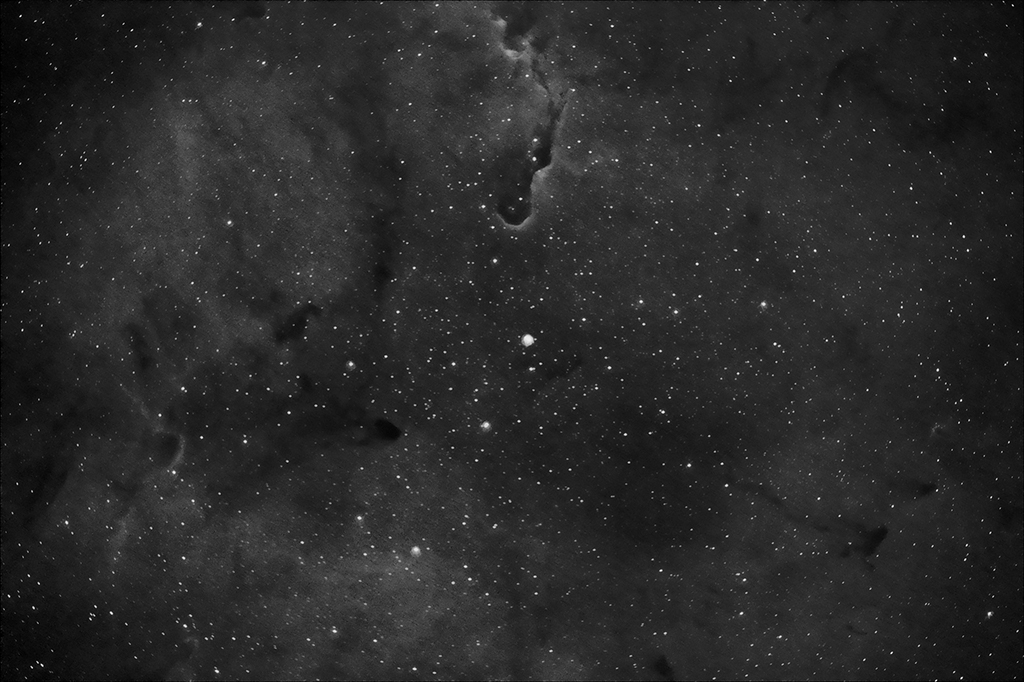
Elephant Trunk in H-alpha

The Elephant's Trunk nebula is a concentration of interstellar gas and dust in the star cluster IC 1396 – an ionized gas region located in the constellation Cepheus about 2,400 light years away from Earth. It is commonly called the Elephant's Trunk nebula because of its appearance at visible light wavelengths, where there is a dark patch with a bright, sinuous rim. The bright rim is the surface of the dense cloud that is being illuminated and ionized by a very bright, massive star. The entire IC 1396 region is ionized by the massive star, except for dense globules that can protect themselves from the star's harsh ultraviolet rays.

H-alpha () is a specific red visible spectral line created by hydrogen with a wavelength of 656.28 nm, is visible in the red part of the electromagnetic spectrum, which occurs when a hydrogen electron falls from its third to second lowest energy level. It is difficult for humans to see H-alpha at night, but due to the abundance of hydrogen in space, H-alpha is often the brightest wavelength of visible light in stellar astronomy.

A hydrogen-alpha filter is an optical filter designed to transmit a narrow bandwidth of light generally centered on the H-alpha wavelength. They are characterized by a bandpass width that measures the width of the wavelength band that is transmitted. These filters are manufactured by multiple (~50) layers of vacuum-deposited layers. These layers are selected to produce interference effects that filter out any wavelengths except at the requisite band.


Image Data: Elephant's Trunk Nebula and IC1396

Lens / Scope: William Optics Megrez 102 S.V. with WO Type II 0.8x FF/FR 
Focal Length: 571.2mm 
F/stop: f/5.6 
Exposure: Stack of 30 600-second exposures (5:00 hours total exposure) 
Mount: Sky-Watcher HEQ5 Pro SynScan GOTO (CdC and EQMOD Control) 
Guiding: Sky-Watcher 80 with QHY5 (PHD Control) 
Camera: Canon 500D (Digital Rebel T1i) Baader Mod (EOS Utility Control) 
Mode: RAW 
ISO: 1600
White Balance: Daylight
In-Camera Noise Reduction: Off 
Filter: Omega Optical H-alpha 10nm 
Date: July 22, 2011 
Start Time: 22:50
Location: Beja, Portugal 
Calibration: 30 Darks, 50 Flats, 50 Dark Flats, 50 Bias. 
Processing: Calibrated, aligned and stacked in DSS. Post-processing in Photoshop. GradientXTerminator. Carboni Tools. Noise Ninja.